


Industries Served - Plating Solutions
Due to its unique properties of excellent corrosion resistance, combined with a high wear resistance and uniformity of coating, electroless nickel finds extensive applications. See if one of these apply to you.
 Oil & Gas: Valve components, such as Balls, Gates, Plugs etc. And other components such as pumps, pipefittings, packers, barrels etc. The corrosion and wear resistance and the chemical and electrochemical stability of electroless nickel are critical to the performance of the coating in this market segment. Housings, flanges, pipes, pumps, ball valve bodies and connector sections are commonly plated with thickness of up to 100 microns in the most severe environments. Low-phosphorus electroless nickel has shown promise and performed the best of all electroless nickel types in some of the most severe applications involving exposure to strong alkalis even at elevated temperatures and flow rates.
- Chemical Processing: Heat Exchangers, Filter Units, pump housing and impellers, mixing blades are frequently plated.
- Plastics: Molds and dies for injecting and low and blow molding of plastics components, extruders, machine parts rollers often require some kind of metal finishing
- Textile: Printing cylinders, machine parts, spinneret's, threaded guides require chrome plating
 Automotive: Shock Absorbers, heat sinks, gears, cylinders, brake pistons etc. higher quality and superior performance components and by the public demand for longer warranty vehicles. Brake pistons, wheel cylinders, caliper pins, steering column yokes, pinion shafts, air bag components and transmission parts are all plated in large volumes with electroless nickel. Electroless nickel is also commonly used as the first conductive coating and then coated with copper/nickel/chrome in many decorative applications such as interior hardware and aluminum wheels.
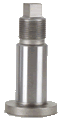 Aviation & Aerospace: Satellite and rocket components, rams pistons, valve components. Aerospace. Compressor and stator components from jet engines have used electroless nickel successfully for many years. In many cases the components coated are either high-nickel-alloy materials or titanium. Drive trains and landing gear components are coated with electroless nickel.
- Our plating services confirm to these specifications and Standards.
- Electroless Nickel Plating ASTM B733
- Electroless Nickel Plating AMS 2404
- Electroless Nickel Plating MIL-C-26074
- Food & pharmaceutical: Capsule machinery dies, chocolates molds, food processing machinery components No coating has blanket USDA approval for use in the food process industry, but electroless nickel (most often high-phosphorus type) is used for a variety of applications, including evaporators in ice machines, bearings, gears, conveyors and chains. Electroless nickel coatings have replaced expensive stainless steel (or have been used to coat stainless steel), because foodstuffs do not tend to stick readily to them. Also electroless-nickel-coated components are not as receptive to stress corrosion cracking as stainless steels (many cleaning compounds use chlorides).
- General Industrial: Shafts for ink-jet printers, heddles for weaving machines, rolls for the printing of newsprint and mold cavities where superior release properties are paramount
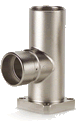 Military specifications for chrome plating Military MIL QQ-C-320 and Electroless Nickel plating MIL-C-26074E for acquisition for parts that conform to this standard.
- Electronics. This market segment is by far the largest and most diverse of all the areas where electroless nickel is used. The major component plated is the aluminum memory disk that is found in many of the computer storage devices. It consumes a huge amount of electroless nickel. The high-phosphorus electroless nickel used in this application has to be exceptionally smooth and non-magnetic to serve as a base for the magnetic layers.
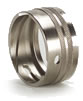 Another large electronic application is coating both aluminum and zinc connectors. The coating serves to provide corrosion protection, wear resistance, and is especially important because of the complex shape of these components. These are for both commercial and military uses. Sometimes a topcoat of cadmium is used, however electroless nickel is used increasingly as a stand-alone coating.
Components for semiconductor packages, ceramic micro-devices, microwave devices, air bearings, battery components, heat sinks and electroless plating of plastics for EMI shielding are all large consumers of electroless nickel. New applications in the electronics sector include floor grates for semiconductor manufacturing facilities and electroless nickel/gold for circuit boards.
Note on Electroless Nickel Corrosion resistance. One of the primary uses of electroless nickel in engineering applications is enhanced corrosion protection of critical components. Because electroless nickel is cathodic to most common metals in most environments, its corrosion protection is not afforded through sacrificial mechanisms. Corrosion protection occurs through encapsulation of the substrate. Electroless Nickel has a low porosity and resistance to many chemicals and atmospheric conditions.
Plating Specifications and Testing
ASTM specifications are generally followed in evaluating Electroless Nickel plated components some of the relevant factors to consider are as follows when selecting your application
- Hardness
- Thickness
- Corrosion Resistance
- Adhesion
